Most countertop appliances begin with the same compromise: decide where the outlet is, route the cord around everything else, and accept that the appliance base will keep occupying that spot even when the product is not being used.
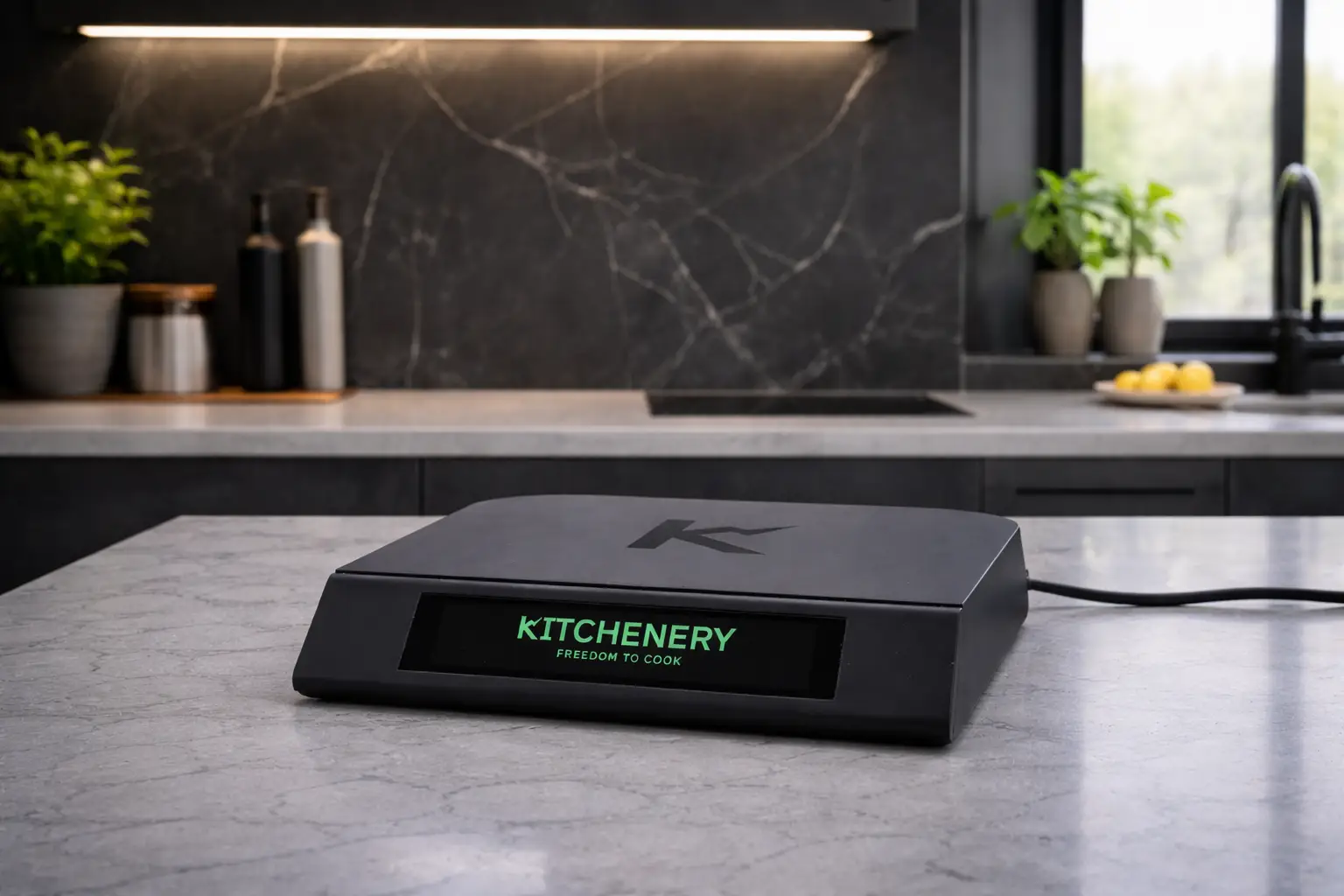
The Kitchenery Quantum Energy Pad is designed to reverse that relationship. Instead of giving every appliance its own permanent connection, the QEP becomes the shared power surface. Compatible products receive energy while they are placed on the pad, and the same surface is designed to support induction-compatible cookware.
That makes the QEP more than an accessory. It is the foundation of the Kitchenery cordless kitchen ecosystem and the reason the Perfect Pour Kettle and Silent Blender can operate without a direct appliance cord or internal battery.
What is the Kitchenery Quantum Energy Pad?
The Quantum Energy Pad is a countertop power platform. It connects to household power through one wall connection, then uses Kitchenery’s wireless power transfer architecture to deliver energy across a small gap to a compatible receiver inside an appliance.
In everyday language, the idea is similar to placing a phone on a wireless charging pad—but the product requirements are very different. A kitchen appliance needs substantially more power, coordinated device recognition, thermal management, product-specific controls, and safe operating behavior. The QEP is being developed as a complete appliance platform, not an oversized phone charger.
How the QEP works

The consumer experience is intended to feel simple even though the engineering underneath is not:
- The Quantum Energy Pad is connected and ready.
- A compatible Kitchenery appliance is placed on the designated active area.
- The surface and appliance communicate so the system can identify the connected product.
- Energy transfers through controlled magnetic coupling.
- The appliance converts the received energy into the power needed for its intended function.
The recognition step matters. The system is not intended to energize every object or every appliance placed on the surface. Kitchenery products need the appropriate receiver-side technology and controls. That compatibility requirement is one of the most important facts for customers to understand.
One surface, two kitchen experiences

Cordless appliance mode
The Perfect Pour Kettle and Silent Blender are designed with receiver technology that lets them draw power while they are on the QEP. They do not need a direct appliance cord, and they are not dependent on a rechargeable battery. Remove the product from the power surface, and it is no longer receiving operating power.
Induction cookware mode
The QEP is also designed to work as an induction cooktop with induction-compatible cookware, subject to the final product configuration, compatibility requirements, and certification. That creates a more useful system: the surface is not reserved only for proprietary appliances when it can also support everyday induction cooking.
Why a shared power surface changes the countertop
Fewer visible appliance cords
A cord is a small object that creates a surprisingly large design problem. It determines placement, catches spills and crumbs, complicates cleaning, and visually interrupts a carefully designed kitchen. Moving the power connection to the shared surface reduces the number of cords attached to the appliances themselves.
More flexible placement
Traditional appliances cluster around outlets. A shared platform lets compatible products be designed around the active power area instead. That can make daily routines more adaptable, especially in compact kitchens where every usable inch matters.
One coordinated interface
Kitchenery’s public prototype interface brings induction, kettle, and blender experiences into one control environment. The product vision is not simply wireless energy; it is a surface that recognizes what has been placed on it and presents the controls that fit that product.
A platform that can expand
The QEP creates a common foundation for future compatible products. A new appliance does not need to begin with a new corded base and a separate visual language. It can be designed as another member of the same ecosystem.
What the Quantum Energy Pad does not claim
New categories are easier to trust when their boundaries are clear. The QEP is not presented as a universal surface for every appliance in your home. Existing products will not automatically work on it. Compatible appliances need receiver technology designed for the system, and cookware must be induction-compatible for induction use.
The QEP also does not make the engineering risks of hardware disappear. Final validation, compliance work, manufacturing controls, durability testing, and product documentation remain part of commercialization. Kitchenery has working prototypes and ongoing beta testing, but the company must continue proving performance through the production journey.
Who is the Quantum Energy Pad for?

The strongest fit is not limited to someone who loves gadgets. The QEP is designed for people who care about how a kitchen feels and functions:
- Design-focused homeowners who want a cleaner, more coordinated countertop.
- Smart-home early adopters who value technology that improves a physical routine.
- Tea, coffee, smoothie, and home-cooking users who want several functions from one surface.
- RV, yacht, tiny-home, and compact-kitchen owners who cannot waste outlets or counter space.
- Interior designers and premium builders looking for a differentiated kitchen experience.
How the QEP appears in the Kickstarter bundles
The current estimated delivery for Kitchenery hardware rewards is December 2026—before Christmas. That date is an estimate and should be followed through official Kitchenery Kickstarter launch updates as testing, certification, production, and logistics progress.
Frequently asked questions
Does the QEP work with any appliance?
No. The appliance must include Kitchenery-compatible receiver technology and controls.
Does the QEP contain a battery?
The QEP is designed as a powered countertop surface, and the launch appliances are designed to operate without internal rechargeable batteries.
Can I cook with my own pan?
The platform is designed to support induction-compatible cookware, subject to product configuration, cookware compatibility, and certification.
Is the QEP just a large wireless phone charger?
No. The basic magnetic-coupling idea is related, but kitchen appliances require a different power architecture, recognition, monitoring, controls, and product integration.
When is delivery expected?
The current estimate is December 2026—before Christmas. Backers should treat it as an estimate and follow campaign updates.
The surface is the product—and the beginning of the platform
Kitchenery is not asking customers to replace one corded appliance with one battery-powered gadget. The Quantum Energy Pad is a different proposition: centralize the power experience, design compatible products around it, and let the countertop operate as a coordinated system.
Explore the Starter, Smooth, and Trio bundles and join the early-access list for the Kitchenery Kickstarter launch.
GET EARLY ACCESS →