

Blenders are often used at the exact moment noise feels most intrusive: early in the morning, during a conversation, while a child is sleeping, or in a compact space where there is nowhere for the sound to go.
They also tend to live permanently beside an outlet, with a heavy base and a cord that has to be wrapped, hidden, or cleaned around. The Kitchenery Silent Blender is designed to challenge both problems at once: create a notably quieter blending experience and remove the direct appliance cord by powering the product through the Quantum Energy Pad.
The product name communicates the ambition, not a promise of absolute silence. Blending still involves a motor, moving blades, ingredients, vibration, and airflow. Kitchenery’s public claim is that the blender is engineered for notably quiet operation—not that it makes no sound.
Why blender noise matters more than a specification
A decibel number can be useful, but the real issue is behavioral. People delay making a smoothie because someone is asleep. They stop a conversation. They move the blender to another room. In an RV, yacht, studio apartment, or open-plan home, the machine can dominate the entire space.
A premium quiet blender should make the routine feel less disruptive. That means looking beyond one motor specification and treating acoustics as a complete product problem: motor behavior, enclosure design, vibration control, airflow, blade interaction, jar geometry, and the way the product is supported on the surface.
Cordless without a rechargeable battery
Portable blenders usually become cordless by shrinking the motor and adding a battery. That is not the Kitchenery approach. The Silent Blender is designed as a full countertop product that receives operating power from the QEP while it is placed on the active area.
There is no direct appliance cord and no internal rechargeable battery to charge between uses. The QEP remains connected to household power and acts as the shared platform for the blender, kettle, and induction cooking experience.
How the Silent Blender works with the QEP
The intended interaction is simple:
- Place the compatible Silent Blender on the Quantum Energy Pad’s active area.
- The QEP and blender identify and communicate with each other.
- The interface presents the blender controls for the connected product.
- The QEP transfers energy through controlled magnetic coupling.
- Select the appropriate mode or speed for the recipe, then remove and store the blender when finished.
This is a closed compatibility relationship. An existing blender will not become wireless by being placed on the QEP. The appliance needs the receiver and control architecture designed for Kitchenery’s platform.
What the Silent Blender is being designed to make
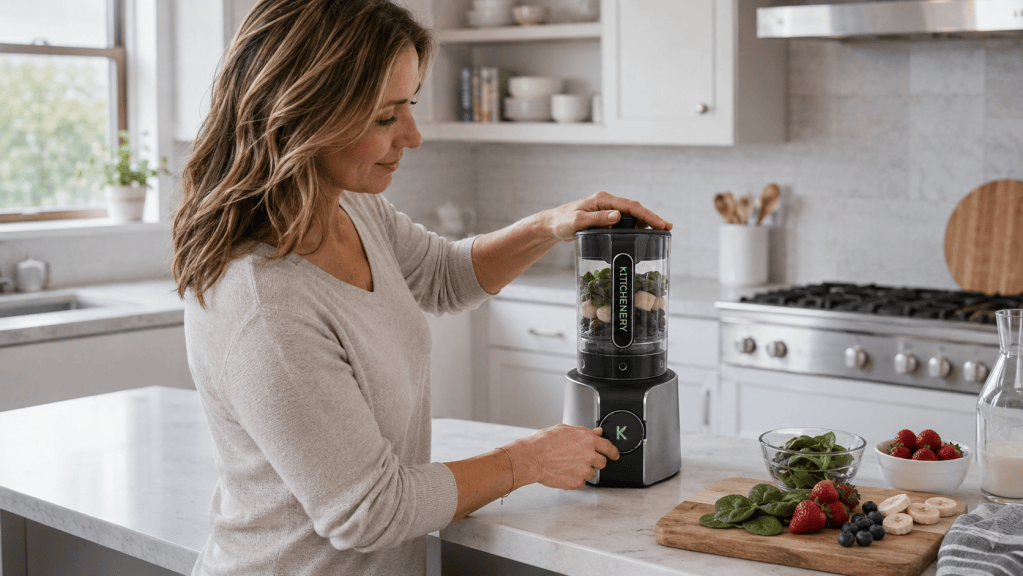
Kitchenery’s current Kickstarter positioning centers the Smooth bundle on familiar, repeatable uses:
- Morning smoothies and protein shakes.
- Blended soups and sauces.
- Everyday ingredient preparation.
- Premium countertop blending in compact or design-led kitchens.
The product should be judged on the fundamentals that matter for those tasks: blending consistency, motor control, jar usability, cleaning, thermal behavior, durability, and acoustics. “Cordless” is only valuable if the blender also performs as a blender.
A cleaner countertop is part of the performance

Countertop products are furniture as much as they are machines. They occupy visual space every day, even when they run for only a few minutes. Removing the direct cord changes where the blender can sit, how it can be stored, and how the surrounding surface can be cleaned.
Because the QEP is shared, the kitchen does not need a separate permanent power base for the blender and another for the kettle. The ecosystem is designed to consolidate the power layer while letting each appliance keep the form and controls appropriate to its task.
Who is the Silent Blender for?
Early-morning households
People who blend before the rest of the home is fully awake have an obvious reason to care about a quieter product. The emotional benefit is simple: prepare the routine without making the appliance the loudest event in the room.
Open-plan and compact spaces
In a studio, tiny home, RV, or yacht, the kitchen is often only a few feet from the bed, desk, or conversation area. Noise and cord placement become bigger problems because the space cannot absorb them.
Design-conscious buyers
The Silent Blender is also for a customer who sees a countertop appliance as part of the room. They want the power, interface, and industrial design to feel coordinated rather than assembled from unrelated products.
What remains before production
Kitchenery has working prototypes and ongoing beta testing. Moving from a functional prototype to a repeatable consumer product requires more than making the blades spin. The team must validate acoustics, thermal performance, motor control, vibration, reliability, mechanical retention, safety behavior, manufacturing tolerances, and user experience.
That is one reason Kickstarter launch communication matters. Backers should be shown evidence of progress: production-intent samples, test methods, design changes, supplier milestones, and the results that support release decisions.

The blender in the Kickstarter bundles
The Silent Blender appears in the Smooth and Trio bundles. The current public early-access page shows the Smooth bundle with one QEP, one blender, and a Honeycomb silicone mat from $1,699. The Trio adds the Perfect Pour Kettle and is currently shown from $2,026. Final launch pricing and tier availability should be confirmed on the Kitchenery early-access page and Kickstarter campaign.
The current estimated delivery is December 2026—before Christmas. Because this is crowdfunded hardware, the estimate can change if final validation, certification, manufacturing, or logistics require more time.
Frequently asked questions
Is the Silent Blender completely silent?
No blender is soundless. “Silent Blender” is the product name, and the product is engineered for notably quiet operation. Final acoustic performance should be supported by production-intent testing.
Does it use a battery?
The product is designed to be battery-free and to receive operating power from the Quantum Energy Pad.
Can it work without the QEP?
No. The Silent Blender is designed as a compatible Kitchenery appliance and requires the QEP power surface.
Can I put my current blender on the QEP?
No. Existing appliances need Kitchenery-compatible receiver and control technology to operate on the platform.
When is delivery expected?
The current estimate is December 2026—before Christmas. Follow official campaign updates for schedule changes.
A quieter routine, not just a quieter machine
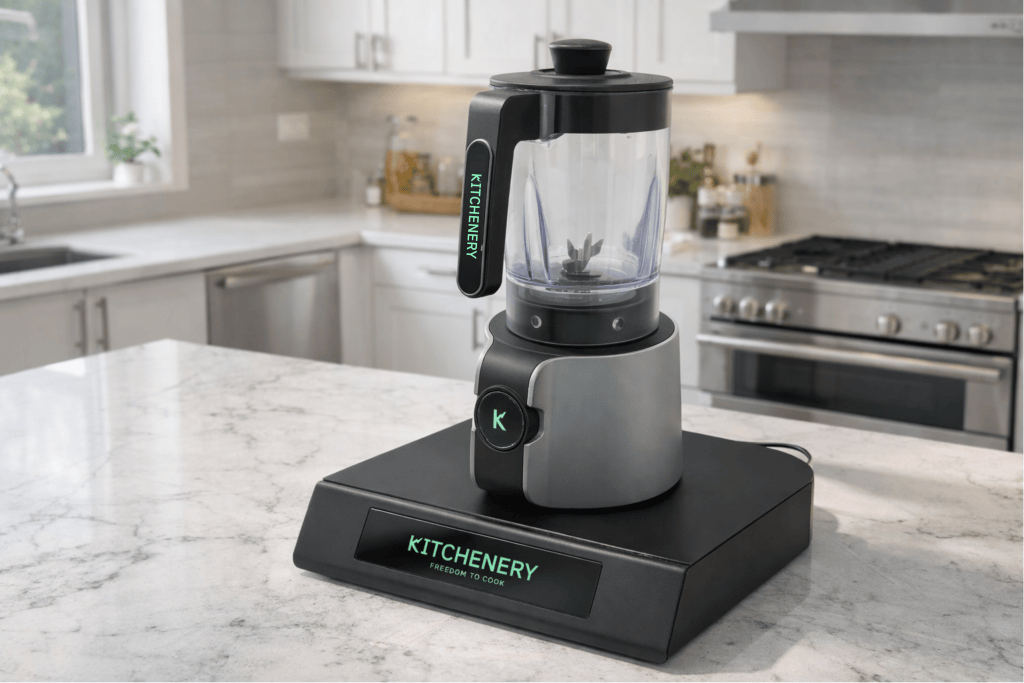
The strongest version of the Silent Blender is not defined by one headline claim. It is a product that blends well, interrupts less, stores cleanly, and belongs to a shared cordless system. That is the experience Kitchenery is bringing to Kickstarter.
Join the Kitchenery early-access list for the Smooth and Trio launch alerts, Super Early Bird information, and the private VIP reward opportunity.
GET EARLY ACCESS →